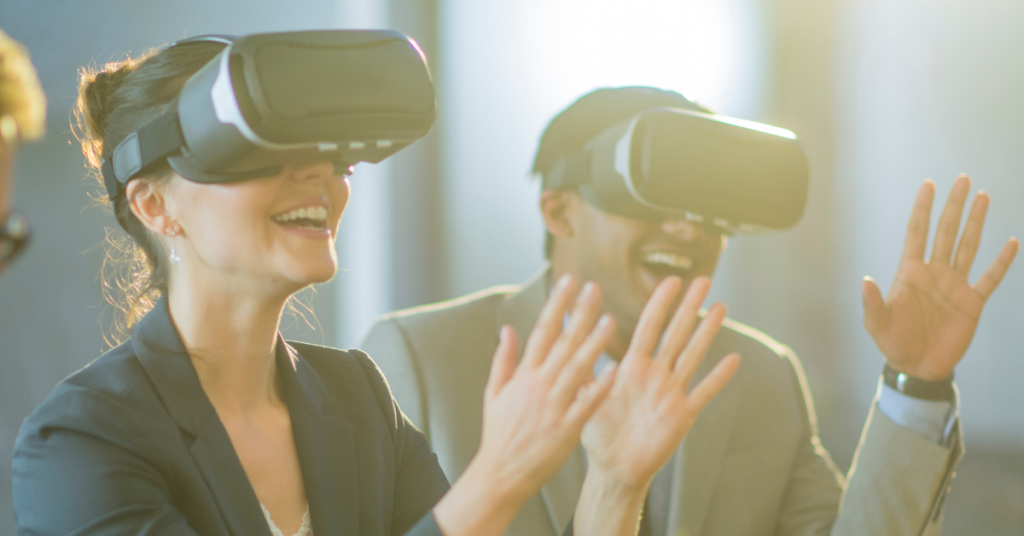


The rapid advancement of technology has ushered in a new era of immersive experiences, with virtual reality (VR) and augmented reality (AR) at the forefront of this digital revolution. These innovative technologies are reshaping how we interact with digital content, offering unprecedented levels of engagement and transforming various industries. In this article, we will delve into the current trends and future potential of virtual and augmented reality, exploring their applications, impact, and the challenges that lie ahead.
What is the difference between Virtual Reality and Augmented Reality?
Defining Virtual Reality (VR) and its characteristics
Virtual reality is an immersive technology that creates a simulated environment, completely replacing the user’s real-world surroundings with a virtual world. VR systems typically utilize head-mounted displays (HMDs) to provide a 360-degree visual experience, coupled with motion tracking and sometimes haptic feedback to enhance the sense of presence within the virtual space. The primary goal of VR is to create a fully immersive virtual experience that engages multiple senses, allowing users to interact with and manipulate digital objects as if they were real.
Understanding Augmented Reality (AR) and its features
Augmented reality, on the other hand, overlays digital content onto the real world, enhancing the user’s perception of their physical environment. Unlike VR, AR does not replace reality but rather augments it by adding computer-generated information, such as images, text, or 3D models, to the user’s field of view. AR applications often utilize smartphone cameras or specialized AR glasses to seamlessly blend virtual elements with the real world, creating an interactive and enhanced version of reality.
Comparing VR and AR technologies
While both VR and AR fall under the umbrella of extended reality (XR) technologies, they differ significantly in their approach and applications. Virtual reality offers a fully immersive experience, isolating users from their physical surroundings, making it ideal for gaming, training simulations, and virtual tours. Augmented reality, conversely, maintains a connection to the real world, making it more suitable for applications that require contextual information overlays, such as navigation, industrial maintenance, and educational tools. The choice between VR and AR depends on the specific use case and desired level of immersion.
How is Virtual Reality transforming education and training?
Benefits of using VR in educational settings
The use of virtual reality in education has revolutionized the learning experience, offering immersive and interactive environments that enhance student engagement and comprehension. VR technologies enable educators to create virtual field trips, historical reenactments, and scientific simulations that would otherwise be impossible or impractical in traditional classroom settings. By providing hands-on experiences in virtual environments, VR helps students visualize complex concepts, improve spatial awareness, and develop problem-solving skills in a safe and controlled setting.
Examples of successful VR implementations in training programs
Various industries have embraced virtual reality for training purposes, recognizing its potential to provide realistic, cost-effective, and scalable solutions. In healthcare, VR simulations allow medical students to practice complex procedures without risk to real patients. The military uses immersive VR environments to train soldiers in combat scenarios and decision-making under pressure. Corporate training programs leverage VR to simulate customer interactions, safety protocols, and equipment operation, resulting in better-prepared employees and reduced training costs.
Challenges and limitations of VR in education
Despite its numerous benefits, the implementation of VR in education faces several challenges. The high cost of VR hardware and software development can be a significant barrier for many educational institutions. Additionally, the potential for motion sickness and eye strain during prolonged VR use raises concerns about the health impacts on students. Educators must also adapt their teaching methods to effectively integrate VR into curricula, which requires time and resources for professional development. Furthermore, ensuring equal access to VR technology for all students remains a challenge in bridging the digital divide.
What are the current trends in Augmented Reality applications?
AR in mobile devices and smartphones
The widespread adoption of smartphones has made augmented reality more accessible than ever before. Mobile AR applications have gained popularity across various sectors, from entertainment to e-commerce. Social media platforms have integrated AR filters and effects, allowing users to enhance their photos and videos with virtual elements. Retailers are using AR to enable virtual try-ons for clothing, makeup, and furniture, improving the online shopping experience. Navigation apps leverage AR to provide real-time directions and points of interest overlaid on the camera view, making it easier for users to explore unfamiliar locations.
Industrial and enterprise AR solutions
In the industrial sector, augmented reality is transforming workflows and improving efficiency. AR-enabled smart glasses and headsets are being used for remote assistance, allowing experts to guide on-site technicians through complex repairs and maintenance tasks. In manufacturing, AR overlays can provide assembly instructions, quality control information, and real-time data visualization directly in the worker’s field of view. Architects and construction professionals use AR to visualize 3D models of buildings in real-world environments, facilitating better design decisions and project planning.
AR in gaming and entertainment
The gaming industry has been quick to adopt augmented reality, creating immersive experiences that blend virtual elements with the real world. Games like Pokémon GO have demonstrated the mass appeal of AR gaming, encouraging players to explore their surroundings while interacting with virtual creatures. Theme parks and museums are incorporating AR experiences to enhance visitor engagement, providing interactive exhibits and personalized tours. As AR technology continues to evolve, we can expect to see more sophisticated and seamless integration of virtual content in entertainment experiences.
How does interaction in virtual environments impact user experience?
Immersive experiences in virtual worlds
The impact of virtual environments on user experience is profound, offering unprecedented levels of immersion and interactivity. Immersive VR experiences transport users to fully realized virtual worlds, where they can explore, interact, and collaborate in ways that were previously impossible. These virtual spaces can range from realistic simulations of real-world environments to fantastical landscapes limited only by the imagination of their creators. The sense of presence achieved in well-designed virtual environments can lead to heightened emotional engagement and improved knowledge retention, making VR a powerful tool for storytelling, education, and therapeutic applications.
User interface design for VR systems
Designing effective user interfaces for virtual reality systems presents unique challenges and opportunities. Traditional 2D interface paradigms often do not translate well to 3D virtual spaces, necessitating new approaches to interaction design. Natural gesture-based controls, gaze tracking, and voice commands are becoming increasingly common in VR applications, allowing for more intuitive and immersive user experiences. Developers must consider factors such as spatial awareness, ergonomics, and cognitive load when creating VR interfaces to ensure comfortable and efficient interactions within virtual environments.
Psychological effects of VR interactions
The psychological impact of virtual reality interactions is an area of ongoing research and debate. While VR experiences can elicit powerful emotional responses and create lasting memories, they also raise questions about the long-term effects of prolonged immersion in virtual worlds. Some studies suggest that VR can be an effective tool for treating phobias, PTSD, and other psychological disorders through exposure therapy. However, concerns have been raised about the potential for VR addiction and the blurring of lines between real and virtual experiences. As VR technology becomes more prevalent, understanding and mitigating its psychological effects will be crucial for responsible development and use.
What are the potential applications of Extended Reality (XR) technologies?
Combining VR, AR, and Mixed Reality (MR)
Extended Reality (XR) encompasses the full spectrum of immersive technologies, including virtual reality, augmented reality, and mixed reality. By combining these technologies, XR has the potential to create seamless experiences that blend the physical and digital worlds in unprecedented ways. Mixed reality, which allows virtual objects to interact with the real environment, represents a middle ground between VR and AR, offering new possibilities for collaborative work, design visualization, and interactive entertainment. As XR technologies continue to evolve, we can expect to see more sophisticated applications that leverage the strengths of each approach to create truly immersive and transformative experiences.
XR in healthcare and medical training
The healthcare industry stands to benefit greatly from extended reality technologies. XR applications in medical training allow students to practice complex procedures in realistic virtual environments, reducing the risk to patients and providing opportunities for repetitive practice. Surgeons can use AR overlays during operations to visualize patient data and guide precise interventions. VR therapy is showing promise in pain management and mental health treatment, offering immersive experiences that can help patients manage chronic conditions or overcome psychological barriers. As XR technologies become more sophisticated, they have the potential to revolutionize patient care, medical education, and healthcare delivery.
Future prospects of XR in various industries
The future of extended reality technologies holds immense potential across a wide range of industries. In architecture and urban planning, XR can enable immersive visualizations of proposed designs, allowing stakeholders to experience and interact with virtual buildings and cityscapes before construction begins. The automotive industry is exploring XR for virtual prototyping, driver training, and in-vehicle augmented reality displays. In the field of remote collaboration, XR technologies promise to create virtual meeting spaces that replicate the feeling of face-to-face interactions, potentially transforming the way we work and communicate across distances. As XR hardware becomes more affordable and software more sophisticated, we can expect to see innovative applications emerge in sectors such as retail, tourism, and entertainment, further blurring the lines between the physical and digital worlds.
How are Virtual Reality systems evolving to enhance immersion?
Advancements in VR hardware
The evolution of virtual reality systems is driven by continuous advancements in hardware technology. Modern VR headsets offer higher resolution displays, wider fields of view, and improved refresh rates, reducing motion sickness and enhancing visual fidelity. Wireless VR systems are becoming more prevalent, eliminating the need for cumbersome cables and allowing for greater freedom of movement. Eye-tracking technology is being integrated into VR headsets, enabling foveated rendering, which optimizes graphics performance by rendering the highest detail only where the user is looking. As VR devices become lighter, more comfortable, and more powerful, they pave the way for longer and more immersive virtual experiences.
Improvements in graphics and rendering technologies
Advancements in computer graphics and rendering technologies are crucial for creating more realistic and immersive virtual environments. Real-time ray tracing, a technique that simulates the behavior of light in virtual scenes, is becoming more accessible, allowing for photorealistic rendering in VR applications. Machine learning algorithms are being employed to enhance image quality, reduce latency, and optimize performance in virtual reality systems. As these technologies continue to evolve, we can expect virtual worlds to become increasingly indistinguishable from reality, opening up new possibilities for immersive storytelling, scientific visualization, and virtual prototyping.
Haptic feedback and sensory integration in VR
To truly enhance immersion in virtual reality, developers are focusing on integrating multiple sensory inputs beyond just visual and auditory cues. Haptic feedback systems, ranging from simple vibrations to complex force feedback devices, are being developed to provide tactile sensations that correspond to virtual interactions. Olfactory displays that can generate scents to match virtual environments are in development, adding another layer of sensory immersion. Some researchers are even exploring the use of galvanic vestibular stimulation to simulate the sensation of movement in VR without physical motion. As these multisensory technologies mature, they promise to create virtual experiences that engage all of our senses, blurring the line between the real and the virtual.
What are the social implications of widespread VR and AR adoption?
Privacy concerns in virtual and augmented environments
As virtual and augmented reality technologies become more prevalent in our daily lives, they raise significant privacy concerns. VR and AR systems have the potential to collect vast amounts of personal data, including biometric information, behavioral patterns, and even details about our physical environments. The immersive nature of these technologies means that users may inadvertently reveal more information than they intend, raising questions about data ownership, consent, and the potential for surveillance. As we move towards a future where virtual and augmented realities are seamlessly integrated into our daily lives, it will be crucial to develop robust privacy frameworks and ethical guidelines to protect users’ rights and personal information.
Impact on interpersonal communication and relationships
The widespread adoption of VR and AR technologies has the potential to significantly impact how we communicate and form relationships. Virtual social spaces and augmented reality overlays could transform the way we interact with others, offering new forms of connection that transcend physical boundaries. While these technologies have the potential to bring people closer together, there are concerns about their impact on face-to-face interactions and the development of social skills in the physical world. As virtual and augmented experiences become more prevalent, society will need to grapple with questions of authenticity, identity, and the nature of human connection in an increasingly digital world.
Ethical considerations for VR and AR technologies
The development and deployment of virtual and augmented reality technologies raise a host of ethical considerations that society must address. Issues such as addiction to virtual experiences, the potential for manipulation through immersive content, and the blurring of lines between reality and simulation all require careful consideration. There are also concerns about the equitable access to these technologies and the potential for creating new forms of social inequality. As VR and AR become more integrated into education, healthcare, and other critical sectors, it will be essential to establish ethical guidelines and best practices to ensure that these powerful tools are used responsibly and for the benefit of all members of society.